
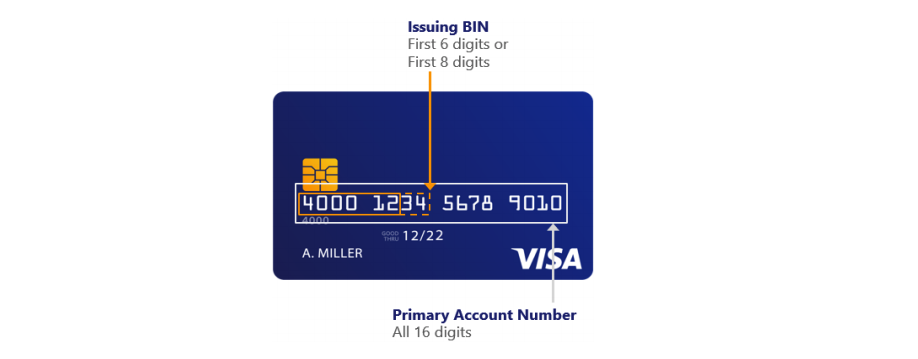
The payments industry is experiencing a shortage of Bank Identification Numbers (BINs), as a result of growing digital payment innovation in recent years. BINs comprise the first six numbers of the primary account numbers (PAN), also visible as the first six digits on credit cards.
To facilitate the growth of the payment industry, the International Organisation for Standardization (ISO) announced the new standard to expand the BIN length from six to eight digits. Effective in April 2022, Visa affirmed the initiative to assign 8-digit BINs for new requests – no longer assigning 6-digit BINs. Visa requires all issuers and acquirers to support the new digit lengths for issuing BINs and for processing in their back-end systems.
Parties affected by the new 8-digit BINs:
- Issuers
- Acquirers
- Processors or Service Providers
- Merchants
How this may affect Service Providers
It is crucial for service providers to accommodate and support the new 8-digit BIN standard by 2022, as failing to do so may negatively affect clients’ experience and their brand.
Service providers will need to determine how the new BIN length will impact their processing or back-end systems to avoid the risk of transaction routing error, failures with incoming data feeds or APIs, or issues with fraud monitoring or cardholder servicing.
Areas where 6-digit BINs are used (but not limited to):
- Transaction processing
- Issuing product management
- Cardholder servicing
- ATM
- Merchant servicing and disputes
- Fraud management
- Data warehousing and reporting
Source: Visa Business News
So… Is Search Dead?
Absolutely not. Search just got a promotion (or a demotion, depending on how you look at it).
Search used to be the creator of demand. Now, it’s the converter of demand.
When discovery does its job, customers search for your brand name or that specific product feature they just saw. If you aren’t bidding on those defensive brand terms, you’re handing your own customers to your competitors.
Remember: Discovery plants the seed. Search reaps the harvest.
3 Actionable Shifts for Your E-commerce Team
If you want to win in this new landscape, here’s what needs to change in your strategy:
1. Break Down the Silos
Your content team, media buyer, and merchandiser need to talk to each other. Why? Because AI algorithms rank your product based on content quality, pricing, stock levels, and reviews—not just your bid. Your ad spend can’t fix a bad product page.
2. Unify Your Signal View
Stop looking at each platform’s dashboard in isolation. Start tracking your Brand Search Volume across all platforms. If your social campaigns are working, you’ll see a direct lift in branded search queries. That’s the halo effect of discovery.
3. Upgrade Your KPIs
Ditch the obsession with “last-click attribution.” Start measuring Incremental ROAS (iROAS) and the growth of your category ranking. You need to give credit to the touchpoints that created the demand, not just the one that closed the sale.
Bottom Line: Rethink Your Keyword Strategy
Today’s shoppers don’t search like robots; they search like humans who just saw a cool product. They’ll type things like “ergonomic chair for back pain” instead of just “office chair.”
Your keyword lists must expand to capture these natural language queries. Furthermore, defensive bidding on your own brand name is no longer optional—it’s survival.
The battle for e-commerce supremacy in 2026 is won or lost before the search button is clicked.
It’s time to stop being a traffic interceptor and start being a discovery guide. Are you ready?